Free samples posted anywhere in the UK✦25-year structural warranty✦The same in-house fitters for over 11 years✦Every enquiry answered within 24 hours✦Free samples posted anywhere in the UK✦25-year structural warranty✦The same in-house fitters for over 11 years✦Every enquiry answered within 24 hours✦
HALLWAY
Hallway Wood Flooring

Wood Flooring
for Hallways.

The hallway is the hardest room to floor correctly — and the most important one to get right. It is the first thing every visitor sees, the most trafficked room in the house, and the space that sets the tone for everything beyond it. LIGNORA installs hallway wood floors across London and the South East.

HerringboneWide PlankChevronUFH CompatibleEntrance Hall
Pattern & Format

Choosing the Right
Hallway Floor Pattern

01
Herringbone

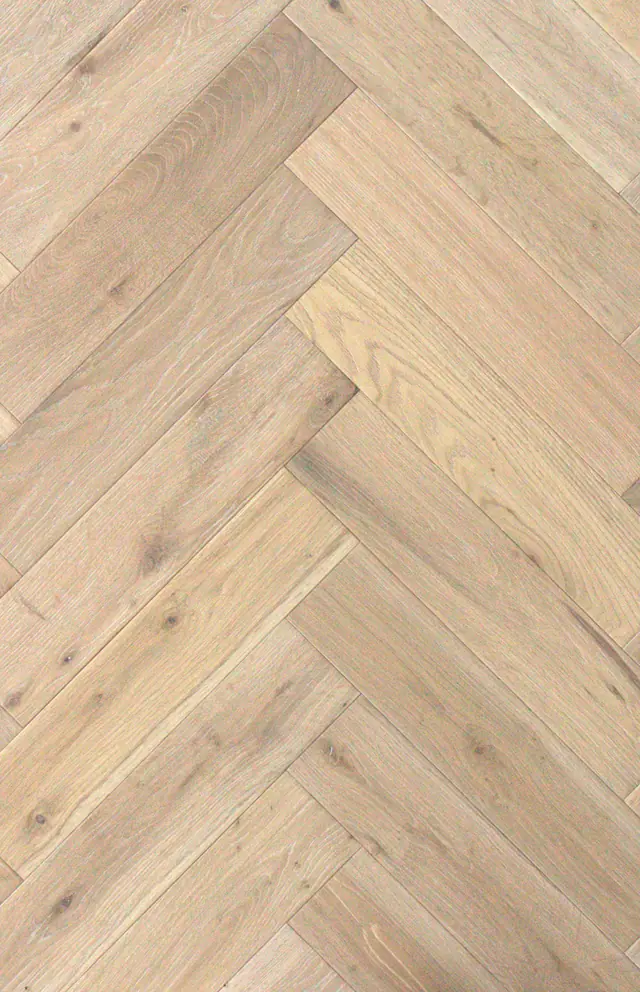
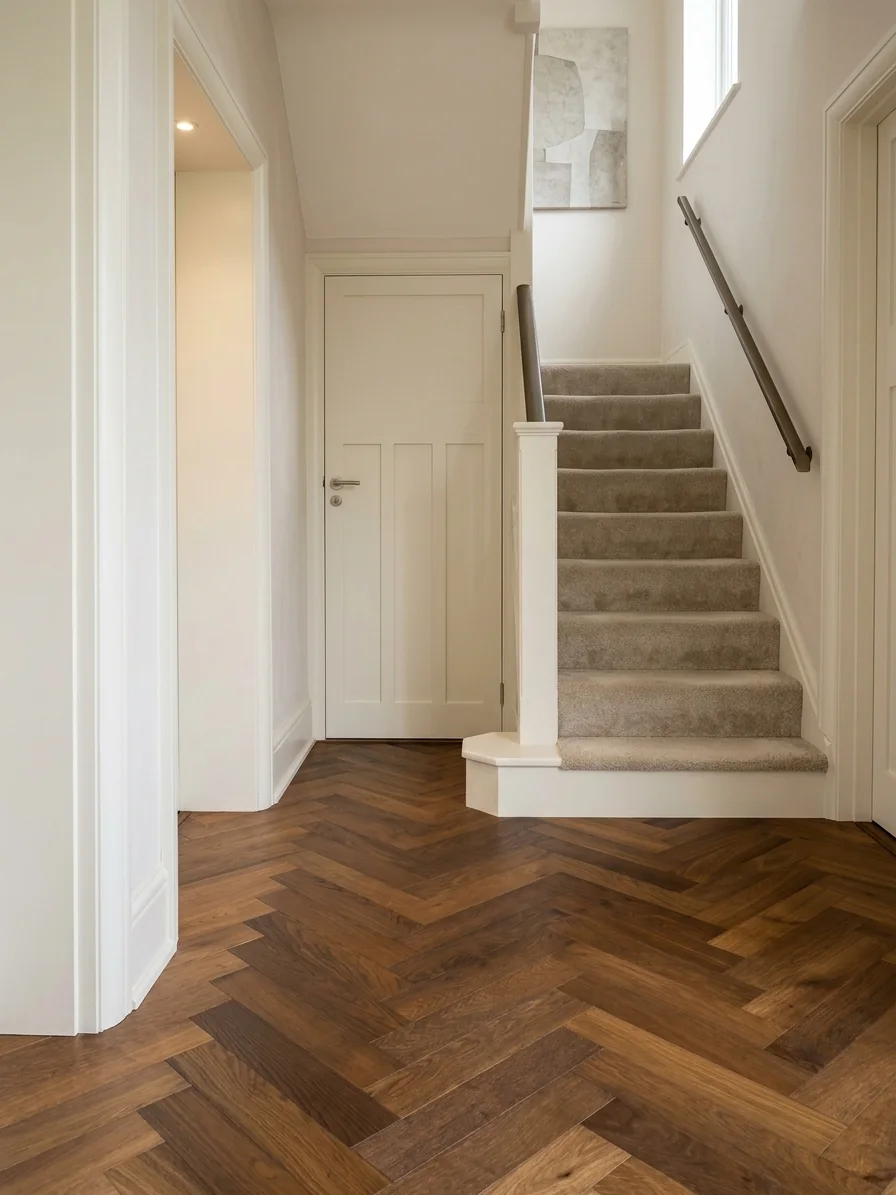
The signature hallway floor across London. Herringbone handles the high traffic of a hallway without showing wear in the way straight-lay boards would — the pattern distributes foot traffic across the diagonal and ages consistently. In narrow hallways, a smaller tile size (90x450mm) maintains the pattern without crowding the space.

Herringbone Flooring London →
02
Wide Plank

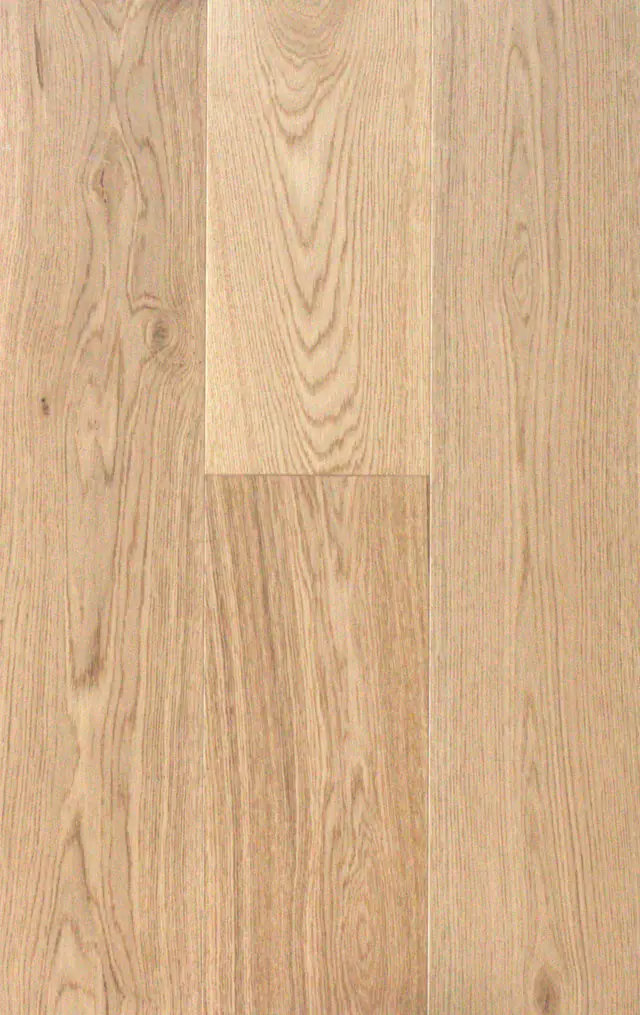
In wider entrance halls and large Victorian reception hallways, wide plank at 190mm creates a generous, calm floor that suits the proportions of the space. Running boards from the front door toward the main reception room draws the visitor through the house — a simple but powerful spatial decision.

Wide Plank Flooring →
03
Parquet Block

Parquet block — individual oak blocks laid in a basket-weave or traditional brick bond — is the correct specification for restoration work in period London properties. If the hallway previously had a parquet floor, we can restore and re-lay the existing blocks, or match the format in new engineered oak where blocks are damaged beyond repair.

Parquet Flooring London →
The Hallway Specification

The Case for Getting it Right First Time

Hallways are the room most likely to be installed incorrectly — and the room where installation errors become obvious fastest. High traffic reveals every subfloor irregularity, every poorly adhered board, every finish that wasn't specified for the use it faces.

Finish specification. Hallways require the hardest finish in the house. We recommend UV lacquer or hardwax oil with a wear layer rated for heavy domestic use — not the same finish we would use in a bedroom. The specification is matched to the traffic the room will actually face.

Threshold details. Hallways connect to more rooms than any other space in the house — front door, living room, kitchen, stairs. Every junction must be planned and detailed correctly. Poorly executed thresholds are the most common point of failure in hallway installations.

First impression value. The hallway floor is visible in every property photograph, and it is the first thing a buyer or tenant steps onto. The return on a quality hallway installation — in perceived value and actual sale price — is as high as any investment in a London property.

What to consider
in a hallway specification

Tile size vs hallway width. A hallway that is 90cm wide needs a different herringbone tile size than one that is 140cm wide. We assess the proportions of the space at survey stage and recommend the tile size that makes the pattern read correctly rather than feeling oversized or cramped.

Continuity into staircase. In London period properties, the hallway floor should be planned alongside the staircase. Whether the staircase is being re-covered at the same time or later, the hallway and stair specification should be agreed together. We advise on staircase wood flooring as part of the hallway survey.

Front door threshold. The threshold between external and internal at the front door is a critical detail. We specify the correct external threshold bar and ensure the floor begins at the right point relative to the door swing and mat well if present.

Samples brought to every survey
Survey to Installation

What Happens at
a Hallway Survey

01
Samples in Your Light

We assess the hallway dimensions, light, and connection to adjacent rooms. Samples are brought and assessed against the specific light of your entrance — often very different to the rest of the house. We recommend tile size, pattern, and finish together.

02
Subfloor Assessment

Hallway subfloors in London properties are the most variable we encounter — tiled over concrete, suspended timber, screed over underfloor heating, or combinations of all three. We identify what is present and confirm the correct preparation and adhesive specification before work begins.

03
Threshold Planning

We plan every door threshold at survey stage — living room, kitchen, cloakroom, external front door. Each junction is specified and priced as part of the installation. On installation day there are no surprises, no additional costs, and no half-finished edges waiting for a return visit.

04
Fixed Price Quote

You receive a fully itemised quote after the visit: boards, underlay, adhesive, installation and threshold work, all listed.

Hallway Width &
Board Direction

The width of a hallway decides the board size and pattern more than anything else. Measure the hall at its narrowest point — usually beside the stairs or a radiator — and use the guide below.

Under 1m
Narrow hallways

Typical of Victorian and Edwardian terraces. Choose herringbone in 90 × 400mm or 90 × 450mm blocks so at least three or four full blocks sit across the width, or plank boards of 125–150mm laid lengthways. Wide boards look cramped here.

Herringbone floors →
1m – 1.4m
Standard hallways

Most hallways. Herringbone at 90 × 450mm or 125 × 600mm reads well, as does plank at 150–190mm. Chevron at 90 × 510mm starts to work from this width, with the point running towards the main room.

Chevron vs herringbone →
Over 1.4m
Entrance halls

Large reception halls can take the bigger formats: herringbone at 125 × 600mm or 150 × 600mm, or wide plank at 190–260mm. A border around the herringbone frames the space in period houses.

Wide plank floors →

Which way should the boards run? In almost every hallway, lengthways — from the front door towards the back of the house. It makes the hall look longer, needs fewer cuts and lines up with the main direction of traffic. Boards laid across a narrow hall make it feel wider but chopped up, and every board ends at a wall.

Herringbone and chevron: set the pattern on the centre line of the hall so the cut blocks at each wall are the same size, with the V pointing down the hallway towards the main room.

How much flooring do you need? Multiply the length by the width at each section of the hallway, add them together, then add 10% for plank or 15% for herringbone and chevron to cover cuts. Include the area under any radiators and into door openings.

Planning the stairs too? Agree the hallway floor and the stair treads together so the colour and direction carry through. Oak stair treads →

Hallway Floors,
Answered

The questions we are asked most often.

Ask Us Anything →
What size wood flooring is best for a narrow hallway?
For hallways under 1m wide, choose herringbone in 90 × 400mm or 90 × 450mm blocks so three or four full blocks sit across the width, or plank boards of 125–150mm laid lengthways.
Which way should wood flooring run in a hallway?
Lengthways, from the front door towards the back of the house, in almost every hallway. It makes the hall look longer, needs fewer cuts and follows the main direction of traffic.
How much wood flooring do I need for a hallway?
Multiply the length by the width of each section of the hallway, add them together, then add 10% for plank or 15% for herringbone and chevron to cover cuts.
Where should a herringbone pattern start in a hallway?
On the centre line of the hall, so the cut blocks at each wall are the same size, with the V pointing down the hallway towards the main room.

Floors to start with

A few floors from the range. Each has its own page with the full specification, a spec sheet and a free sample posted to you.

Fitted by LIGNORA

Recent floors laid by our own in-house team. Order free samples to see the boards in your own light.

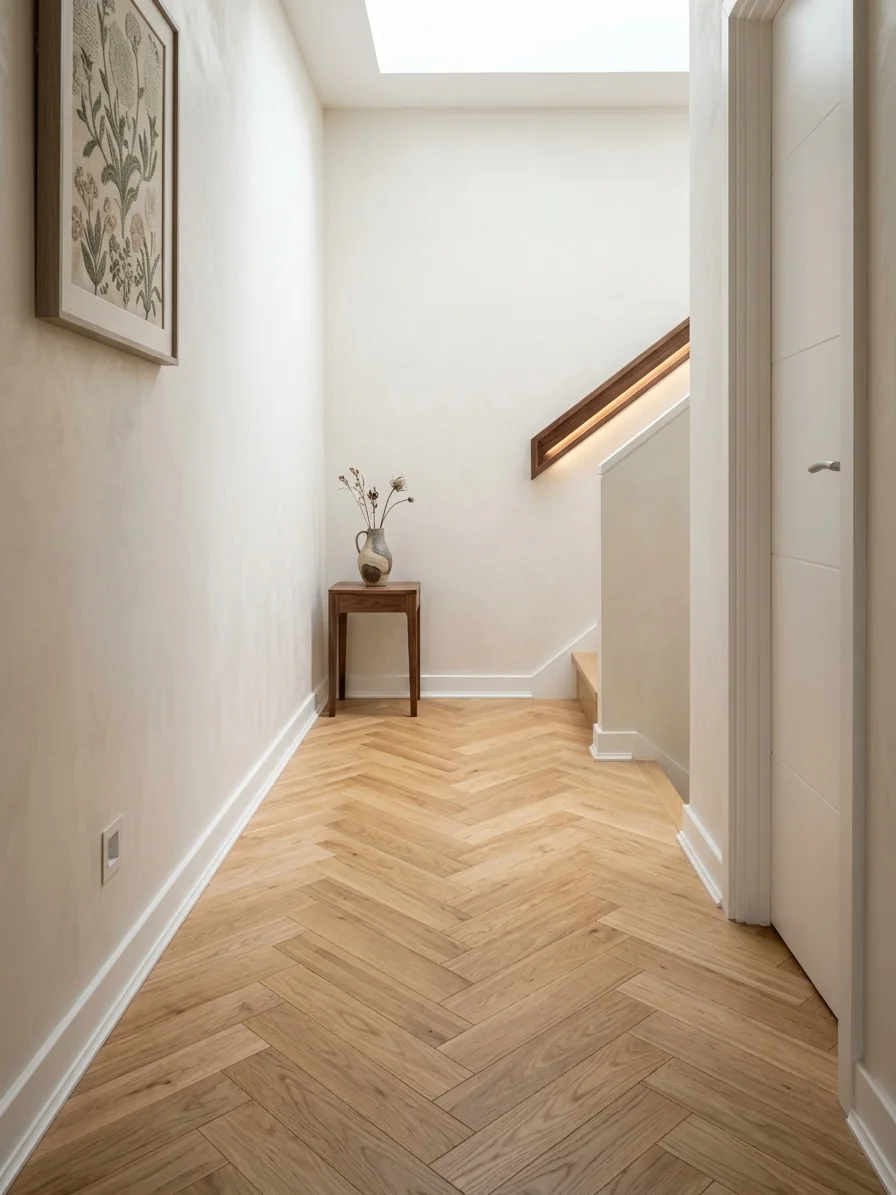
Natural oak herringbone flooring along a narrow hallway towards the stairs, fitted by LIGNORA
Natural oak herringbone in a narrow hallway
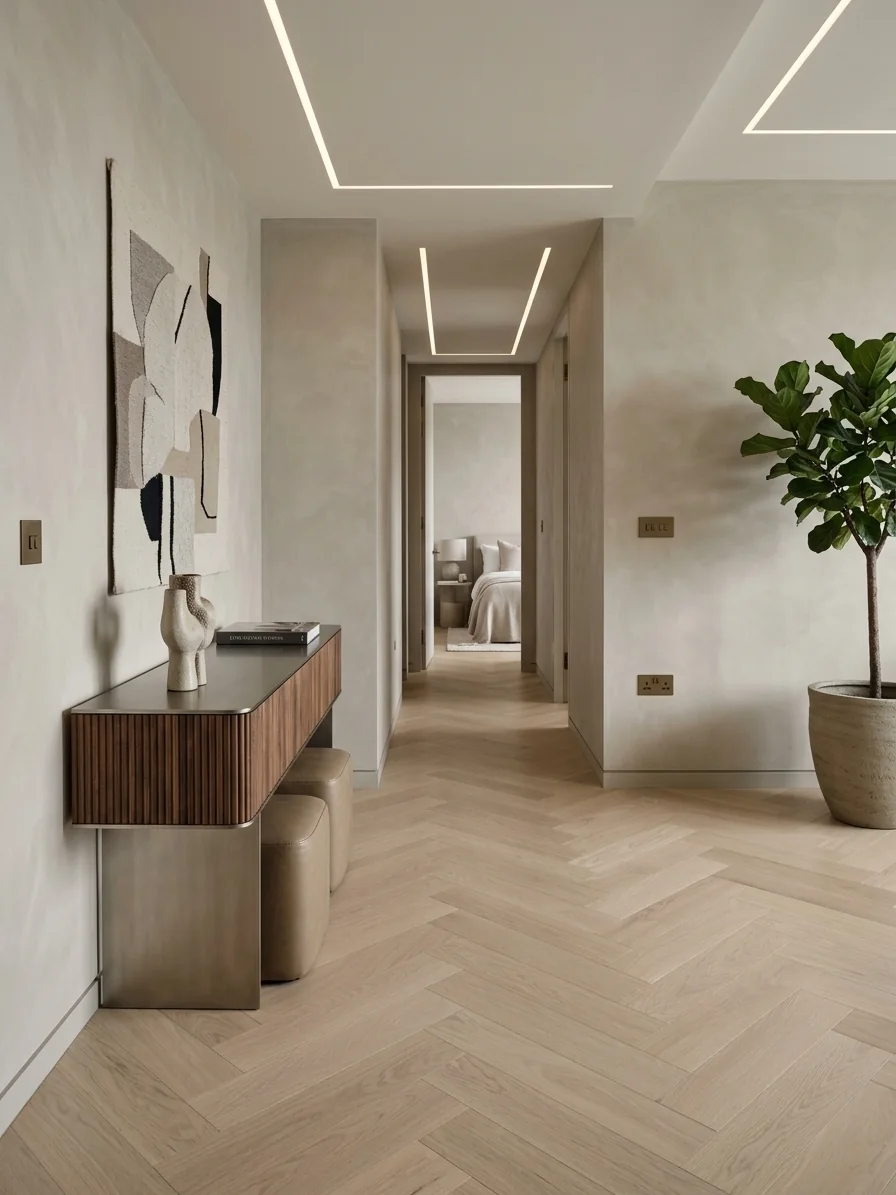
Pale oak herringbone flooring along an apartment hallway, fitted by LIGNORA
Pale oak herringbone along a long hallway · Light oak flooring
Smoked oak herringbone flooring in an entrance hallway at the foot of the stairs, fitted by LIGNORA
Smoked oak herringbone in an entrance hall · Smoked oak flooring
See more of our projects →

Choose your floor
in your own light.

Order free samples to see them at home, or send us a photo of the room and we will suggest where to start.

Order Free Samples →Get in Touch
From a seed to a legacy — generations of craft with LIGNORA