From cost and lead times to underfloor heating, pattern choice, and how we work — straight answers to the questions we hear most often. If yours isn't here, call us directly and we'll answer it the same way.
LIGNORA is a London-based wood flooring specialist offering supply and installation of engineered oak across all London boroughs and the South East. Every installation is carried out by our own employed team — we do not subcontract. We cover herringbone, chevron, wide plank, straight lay, and bespoke patterns across residential and light commercial projects.
All London boroughs for supply and installation — central, north, west, south-west, and east London. Into the South East including Surrey, Kent, Essex, and Hertfordshire. Regularly served areas include Mayfair, Kensington, Chelsea, Belgravia, Knightsbridge, Marylebone, Hampstead, Richmond, Wimbledon, Esher, Guildford, and St Albans, among many others. Full coverage map →
No. Every LIGNORA installation is carried out by our own employed team. We never subcontract installation work. This matters because it eliminates the accountability gap that exists when a supplier and installer are separate companies — if something needs attention, one call to us is all it takes.
Pre-finished stocked products: 2–4 weeks from confirmed order. Bespoke and custom floors: 8–10 weeks from confirmation. We recommend booking the survey early in your project timeline — particularly for new build and extension projects where the installation window is determined by other trades finishing.
A typical room of 20–30 sqm takes one to two days. A full ground floor of 80–120 sqm typically takes three to four days. Herringbone and chevron patterns take longer than straight-lay due to the additional cutting and layout time. Subfloor preparation, if needed, adds time before the installation itself begins.
We visit your property and assess the subfloor — type, level, moisture content, and any preparation required. We bring a selection of samples and assess them in your actual light. We discuss pattern, finish, and product options. After the visit, you receive a fixed written quote covering product, preparation, installation, and all threshold details. No hidden costs.
Yes. Order samples from our product pages and we post them to your address. We also bring a full selection of samples to your home as part of our free survey visit. Seeing samples in the actual light of your room is the most reliable way to choose — showroom lighting never replicates natural or domestic artificial light accurately.
In many cases, yes. We assess the existing floor at survey — species, board width, finish type, and wear level — and advise on the closest available match. Where an exact match is not achievable, we advise on how to handle the junction cleanly through a threshold detail or a deliberate pattern change that reads as intentional.
Engineered oak is the best choice for most London homes. It handles the humidity variation of a Victorian or Edwardian property better than solid wood, is compatible with underfloor heating, and is available in every finish and pattern. For period properties, a brushed and hardwax-oiled engineered oak in herringbone or wide plank is the most versatile and authentic-looking specification.
For most London applications, yes. Solid wood expands and contracts significantly with humidity — a problem in properties with underfloor heating, radiators, and seasonal variation. Engineered oak has a plywood or HDF core that resists this movement while presenting a real oak surface. It is also UFH-compatible, which solid wood is not. Full comparison →
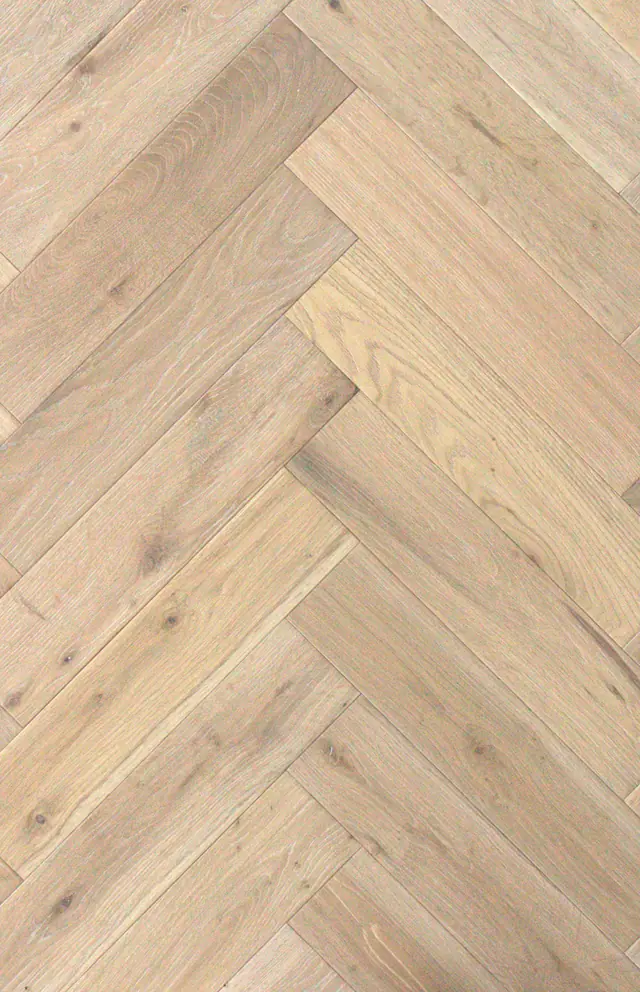
Herringbone is a laying pattern where rectangular planks are arranged at 90-degree angles, creating a zigzag effect. It is one of the oldest wood flooring patterns and the most popular in London hallways, reception rooms, and kitchen-diners. Typically installed in 90x450mm or 125x600mm tiles, glue-down to the subfloor. Herringbone flooring London →
Herringbone uses rectangular boards staggered at 90 degrees — they do not meet at a point. Chevron boards are cut at a 45-degree angle so they meet in a V-point, creating a continuous arrow pattern. Chevron is more formal and symmetrical; herringbone has more movement and rhythm. Both are glue-down installations. Full comparison →
Engineered oak in herringbone or wide plank with a brushed and hardwax-oiled or lightly smoked finish suits Victorian and Edwardian properties best. Reclaimed oak or character-grade engineered oak with natural oil finishes suits the material honesty of period architecture better than high-gloss or very uniform finishes. Period homes guide →
Engineered oak with a hardwax oil finish is the best specification for most London kitchens. Hardwax oil allows localised repairs — spills wipe clean quickly, and individual damaged areas can be spot-repaired. UV lacquer is the alternative for lower-maintenance cleaning. Neither should be used in bathrooms, wet rooms, or areas where standing water is likely. Kitchen flooring guide →
LVT has genuine advantages in wet areas — bathrooms and wet rooms — where real wood is not suitable. For living rooms, hallways, bedrooms, and kitchens in a London home, engineered oak outperforms both LVT and laminate on feel, sound, repairability, longevity, and property value impact. LVT vs real wood →
Yes. Most engineered oak floors can be lightly sanded and refinished. The number of times depends on the wear layer thickness — typically 3–6mm on a quality board. A standard professional sand removes approximately 0.5–1mm. Budget engineered floors with 1–2mm wear layers cannot be meaningfully refinished. All LIGNORA products have wear layers of 3mm or above.
Wood flooring installation in London typically costs between £60 and £120 per square metre for supply and fit, depending on product grade, pattern complexity, and subfloor condition. Herringbone and chevron installations cost more than straight-lay due to additional cutting and layout time. Our free home visit includes a fixed written quote covering all costs. Full cost guide →
Yes. All engineered oak in the LIGNORA range is compatible with wet and electric underfloor heating. Maximum permitted floor surface temperature is 27°C. The UFH must be commissioned and run at operating temperature for seven days, then turned off 48 hours before the wood floor is laid. We confirm the UFH specification and adhesive system at survey stage. UFH compatibility →
Hardwax-oiled floors: sweep or vacuum regularly, damp-mop with pH-neutral wood floor cleaner, apply maintenance oil once a year. Individual scratches can be repaired locally. UV-lacquered floors: sweep or vacuum regularly, damp-mop with a wood floor cleaner — no annual oiling required. Lacquered floors cannot be spot-repaired; deep scratches require professional attention. Full maintenance guide →
Herringbone and chevron installations typically cost 15–25% more than straight-lay installations for the same product. The additional cost reflects the increased labour time — cutting at 45 or 90-degree angles, more complex layout planning, and higher material wastage due to the pattern cuts at room perimeters. The additional cost is a one-time investment for a floor that lasts 25–40 years.
Yes — consistently. Estate agents and property valuers treat real wood flooring in reception rooms, hallways, and principal bedrooms as a premium finish that justifies a higher asking price. The return is highest in London where buyer expectations for premium properties are well-defined. LVT and laminate do not deliver the same uplift.
In most cases, yes — particularly original Victorian pine, Edwardian oak, and period parquet. We assess the floor in person before advising. If the boards are structurally sound, a professional sand and refinish is almost always the better economic and environmental choice compared to ripping out and replacing. Sand & restore service →
Every enquiry is answered personally. No chatbots, no contact forms that go nowhere. Call Hendricks on 07380 458 062 or send us a message.