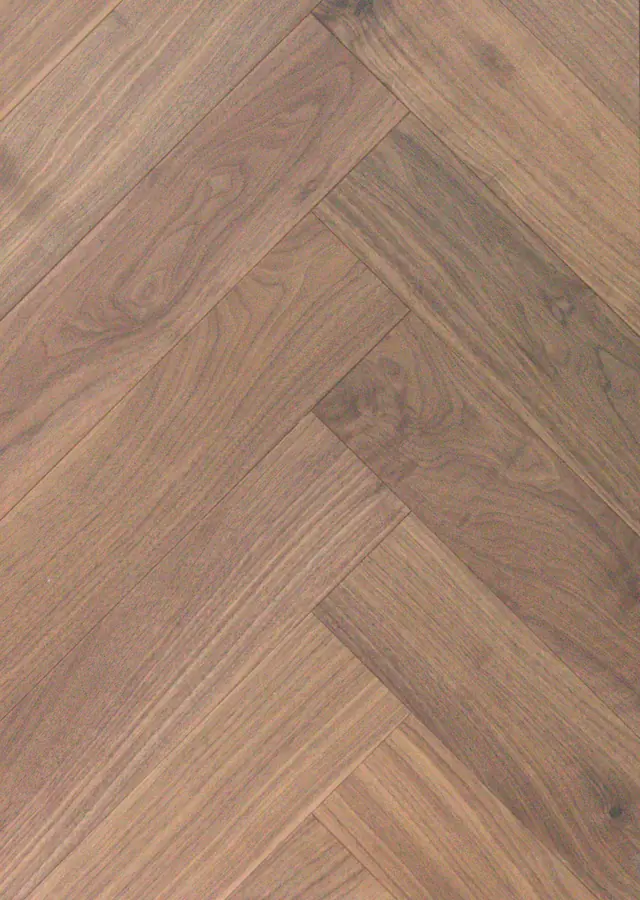
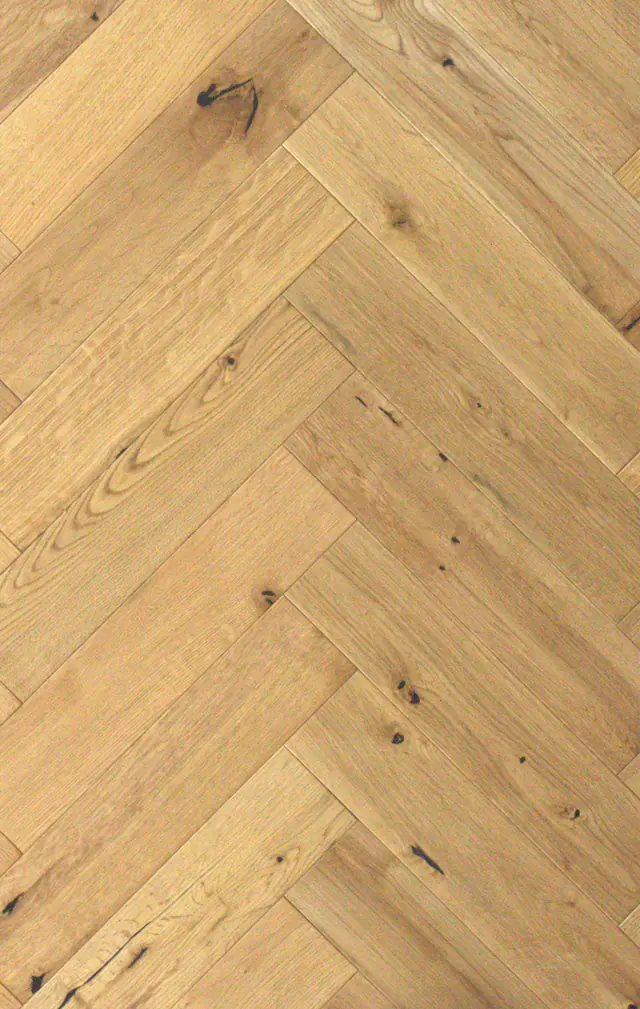
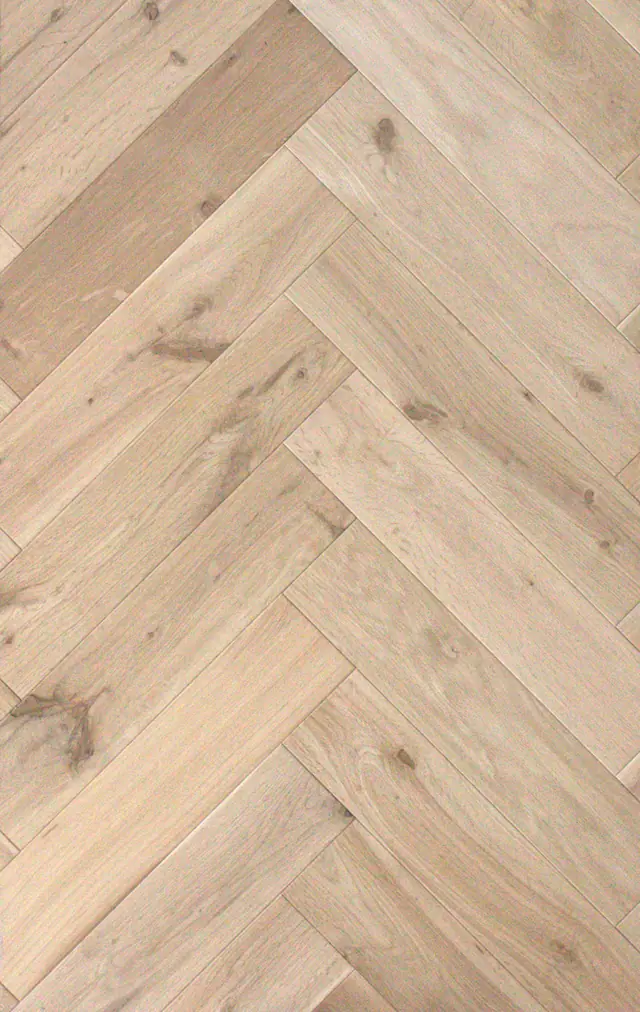
Both patterns are timeless. Both suit period and contemporary interiors. The differences are real, and the choice matters — to the look of the room, the cost of the installation, and the amount of material you will need. Here is an honest comparison from a team that installs both every week.
Rectangular blocks laid at 90° to each other — one horizontal, the next vertical. The joint between each block lands at the midpoint of its neighbour. The result is a zigzag that reads as movement when you look along the room's length.
The pattern has directionality — it pulls the eye along its axis. Laid lengthways in a hallway, it draws you forward. Laid diagonally in a large room, it centres the space. The angle of the diagonal (usually 45°) is set at the outset and determines how the pattern reads from the room's entrance.
Herringbone is forgiving of rooms that are not perfectly square. Because each block is independent, the pattern adjusts at walls and transitions without the precision cuts that chevron demands.
Original Victorian Pattern • More Forgiving to InstallBlocks are cut at 45° so their ends meet in a continuous V-point. Unlike herringbone — where block ends are square — chevron blocks are parallelograms. The joint runs straight across the floor, creating a clean, unbroken arrow that points in one direction.
The result is sharper and more geometric than herringbone. Where herringbone reads as warm and characterful, chevron reads as precise and architectural. It suits rooms with strong visual lines — large open-plan spaces, double-height entrance halls, formal reception rooms.
The continuous V-joint means any misalignment is immediately visible. Chevron demands a flatter subfloor, more precise installation, and more waste at the edges than herringbone.
More Geometric • Requires More PrecisionChevron costs more to install. The angled cuts at every block edge produce more waste — typically 10–15% more material than herringbone in the same room. The installation is also more labour-intensive, adding to the overall cost.
For a 40m² room, the difference in material and labour between herringbone and chevron is typically £400–£800 at current rates. We can quote both and let you compare.
Herringbone: Lower CostBoth patterns work in rooms of any size — but the block size matters more than the pattern type. A 90×450mm herringbone block in a small room (under 20m²) can feel fussy. The same room in a 70×280mm block reads more comfortably.
We advise on block size as part of the consultation — the right block for the room is more important than which pattern you choose.
Both: Scale to Block SizeHerringbone is the historically correct pattern for Victorian and Edwardian properties — original parquet floors from this period are almost always herringbone. It suits period proportions and traditional interiors without appearing to try.
Chevron reads as a deliberate contemporary choice — it was not the standard domestic floor pattern before the 20th century. In a Georgian townhouse, it can look slightly forced. In a 2010s new build, it looks exactly right.
Herringbone: Period • Chevron: ContemporaryBoth patterns require a flatter subfloor than straight-lay boards — typically no more than 3mm deviation over 1800mm. Chevron is less tolerant of any variation because its continuous V-joint makes irregularities immediately visible.
We assess and prepare the subfloor before any patterned installation. In older properties where the subfloor has significant variation, herringbone is often the more practical answer.
Chevron: Higher Tolerance RequiredWe install both patterns every week and have no preference between them — the right answer depends entirely on the room and the client's brief. That said, there are clear patterns in what tends to work.
Herringbone is usually the stronger choice for: period properties (Victorian, Edwardian, Georgian); rooms where warmth and character matter more than geometric precision; projects where budget is a consideration; kitchens and hallways where a more relaxed pattern reads better than a formal one.
Chevron tends to work better for: contemporary and new-build properties; large open-plan spaces where a clear directional line organises the room; formal reception rooms and entrance halls where precision is part of the brief; clients who have seen chevron in a specific reference and know that is what they want.
The honest answer is: come and see samples of both in your property under your actual light, with your furniture. That is the only test that matters.
We bring samples of both patterns to your home, lay them on the floor in your actual light, and advise on which reads better in your specific space. No commitment required.