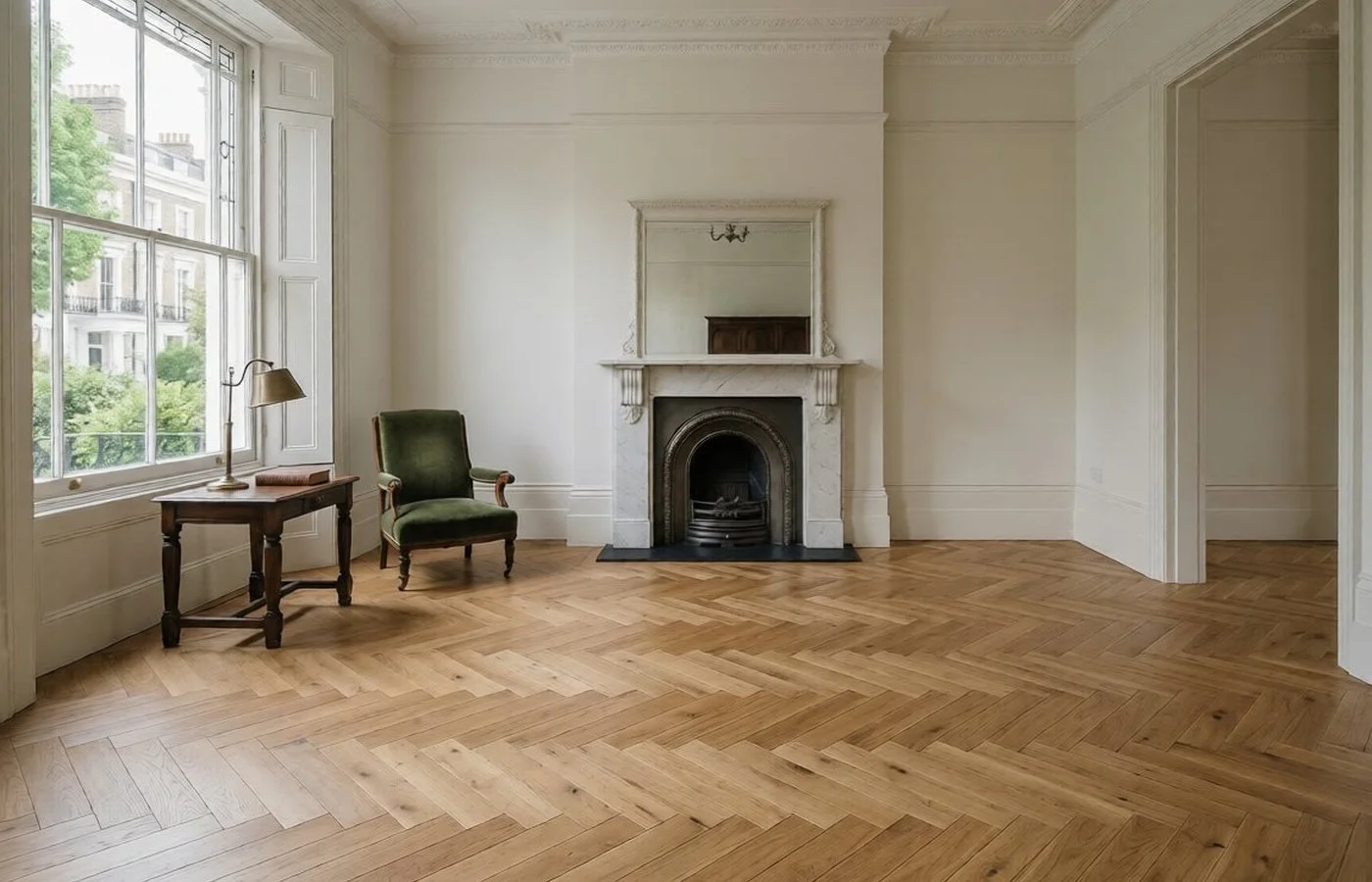
This four-storey Chelsea townhouse had been extensively renovated but the ground floor still held its original Victorian pine boards — stained, damaged, and uneven. The client wanted a single floor that would run continuously from the front door through the hallway, into the double reception room, and through to the rear kitchen-diner. The total area across the ground floor was 94 square metres.
Smoked oak herringbone throughout — the client had seen a similar installation in a neighbouring property and knew exactly what they wanted. The key requirement was continuity: no change of material at any threshold, no transition strips, the floor to feel like a single connected surface across all rooms.
The secondary requirement was longevity. This is a family home with young children and a dog. The finish needed to be hardwearing and maintainable without professional intervention for everyday marks.
The Victorian floorboards were removed and the subfloor was fully prepared — levelled, dried, and primed — before installation began. The herringbone pattern was set out centrally in the hallway and carried through each room in a consistent orientation, so the geometry reads correctly from any vantage point in the open-plan space.
The floor is a 120 × 600mm engineered oak in a smoked finish, wire-brushed and finished in hardwax oil. The brushed surface texture means everyday marks are absorbed into the grain rather than sitting on a flat lacquered surface.
The floor reads as exactly what the client asked for: a single connected surface that moves through the house rather than stopping at each room. The smoked oak sits well against the existing lime-plastered walls and the white-painted joinery. Three years on, the client reports the floor is performing exactly as expected — no gaps, no movement, no issues with the subfloor.
Planning a floor nearby? Our page on herringbone flooring in Chelsea covers the homes we work in around Chelsea, with floors to start from and free samples.
Every enquiry reaches us directly; we respond inside one working day. We keep it personal.
About This Project
The client had a clear brief: smoked oak herringbone throughout the ground floor of a Victorian townhouse off the King's Road — connected from the entrance hall through the main reception and into the rear kitchen extension. The 94m² covered three rooms that needed to read as a single continuous surface.
The subfloor was concrete throughout — the original timber joists had been replaced during a previous renovation. This suited a glue-down installation, which is the most stable method for herringbone on concrete. We self-levelled the screed in two areas where there was sufficient variation to affect the herringbone point.
The smoked oak was chosen for its warmth — the smoke process gives the wood a depth of colour that a stained floor cannot replicate. The boards were acclimatised in the property for five days before installation began, and the floor was finished on-site with two coats of hardwax oil in the agreed satin sheen.
What Made This Project
Datum line setting
The herringbone datum was set relative to the sightline from the kitchen — so the pattern reads symmetrically from the most-used viewpoint in the space rather than from the front door.
Border-free at threshold
The herringbone was run continuously through each doorway without a border or threshold strip — the pattern flows through the house as a single surface rather than room by room.
On-site hardwax oil finish
A factory-finished board could not have achieved the exact satin level the client wanted. Two coats of hardwax oil applied on-site, with a light buff between coats, produced the depth of finish the brief required.
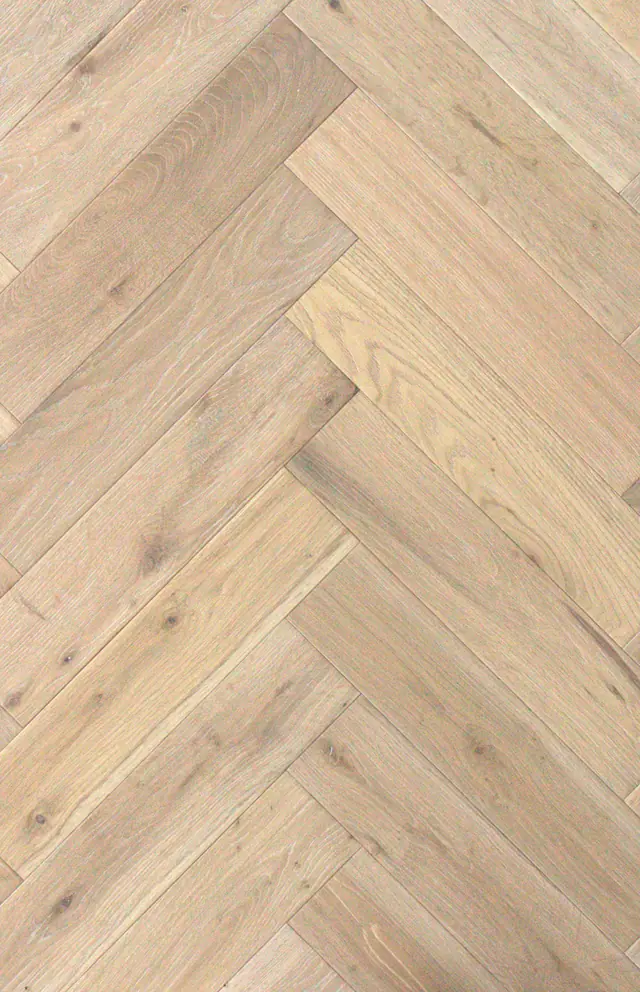
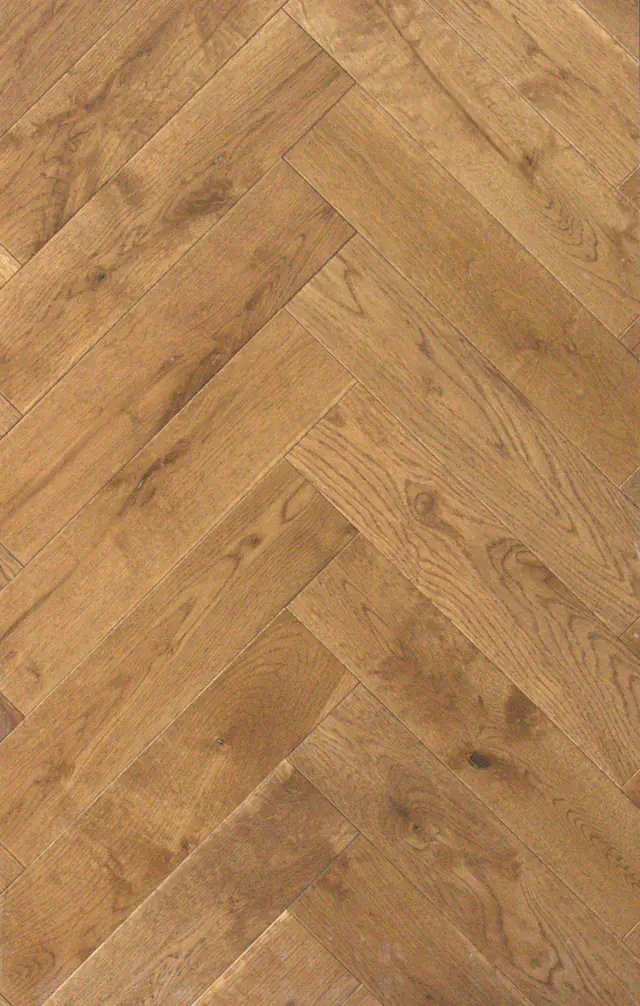
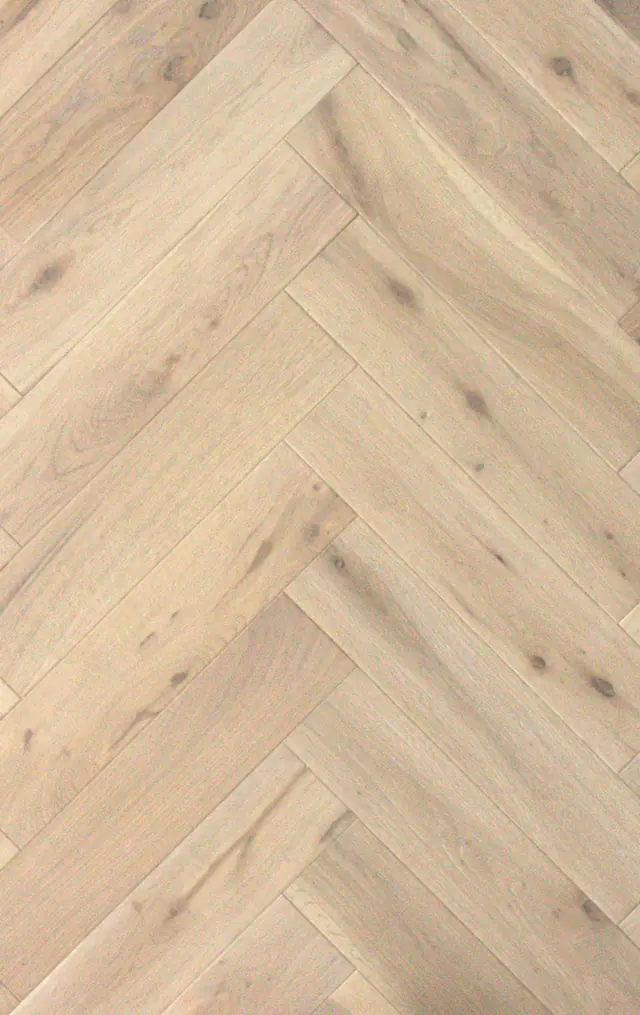
A few floors from the range. Each has its own page with the full specification, a spec sheet and a free sample posted to you.