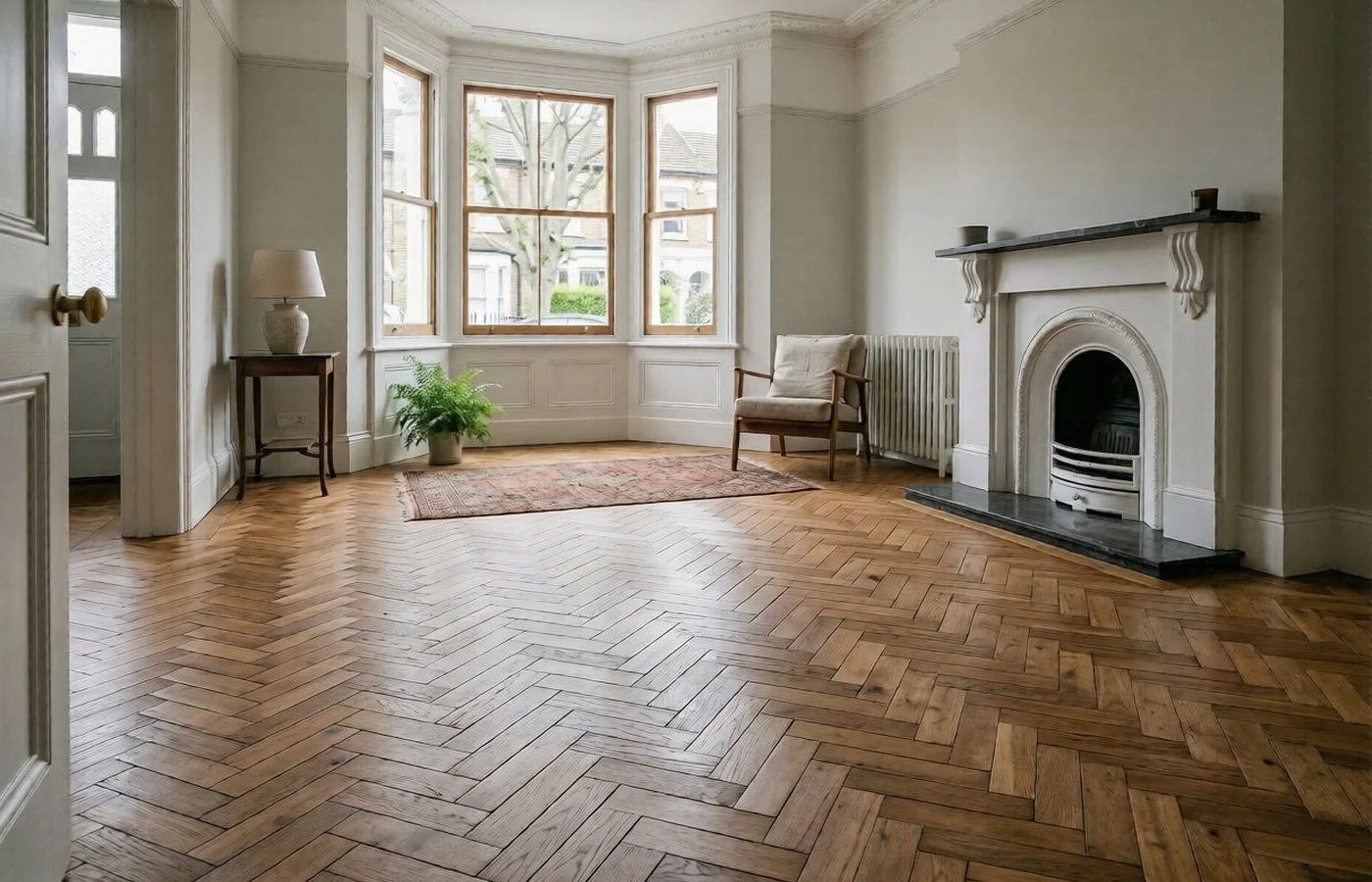
A first-floor flat in an Islington mansion block with original 1930s finger parquet in the reception room and hallway. The parquet had been laid on a bitumen adhesive and was lifting in several areas, with approximately 15% of blocks either missing or irreparable. The client wanted it restored rather than replaced.
The original blocks — small-section oak finger parquet in approximately 230 × 46mm format — were largely sound. The bitumen substrate had failed in patches, allowing the blocks to lift and shift. The solution was a full lift, clean, and re-lay rather than surface treatment alone.
All blocks were carefully lifted and cleaned of the original bitumen adhesive. Replacement blocks were sourced in matching dimensions and allowed to weather to a compatible tone. The subfloor was repaired and primed. All blocks — original and replacement — were re-laid in the original finger pattern using a modern flexible adhesive. The completed floor was then sanded and finished in a mid-tone oil.
The original parquet, re-laid and restored, is indistinguishable in character from what was there before — which was the objective. The replacement blocks will age to match the originals in time. The floor is now structurally sound and can be expected to outlast the building lease several times over.
Each enquiry is reviewed by the team directly, with a reply within one working day. No bots, no queue.
The Restoration Process
The client had been quoted for full parquet replacement by two other contractors. We were asked to provide a third opinion. After assessing the floor in person — walking it, checking block adhesion, measuring remaining block thickness — we recommended restoration. The parquet was structurally sound, the blocks were dense pre-war oak, and the lifting was localised to approximately a third of the area.
Re-adhesion came first. Every lifted block was cleaned, re-bedded with polyurethane adhesive, and weighted overnight before any sanding began. Sanding over a partially-adhered block creates irreversible damage to the pattern — the sequence matters.
The three-pass sand removed ninety years of wax and polish build-up to expose the original block colour — a warm mid-oak that the subsequent hardwax oil finish brought out fully. The cost was approximately 40% of the replacement quotes the client had received.
Block re-adhesion first
All lifted blocks cleaned and re-bedded in polyurethane adhesive. Weighted for 24 hours before sanding commenced. This sequence is non-negotiable — sanding over loose blocks damages both the block and the pattern.
Three-pass dustless sand
Coarse, medium, fine passes — following the herringbone direction throughout. Edges and corners worked by hand where the machine could not reach. Approximately 99% of dust contained.
Hardwax oil finish
Chosen to bring out the natural warmth of the 1930s oak blocks. Applied in two coats with a buff between. The penetrating oil feeds into the wood rather than forming a surface film — producing a result that looks as though the floor has always been finished this way.