Herringbone is one of the oldest flooring patterns in domestic architecture. It appears in Roman mosaics, Tudor great halls, Parisian apartments, and Victorian terraces. And despite the cyclical rise of newer patterns — chevron, brick bond, parquet variations — herringbone remains the one pattern that architects and interior designers return to again and again, particularly in the kitchen.
The kitchen is a working room. It takes more traffic, more spillage, more chair-scraping and boot-wearing than almost any other space in the house. Herringbone's interlocking geometry distributes stress across the floor in a way that straight-laid planks do not — each piece is supported on multiple sides, which makes the installation inherently more stable and more resistant to gapping and movement over time.
That structural argument is practical, but it is not the whole story. Herringbone also draws the eye across the floor in a way that emphasises the expanse of the room rather than its length or width. In an open-plan kitchen-diner — the dominant format in London extensions and basement conversions — this creates a sense of the floor as a single unified surface, even when it flows beneath furniture, islands, and dining areas.
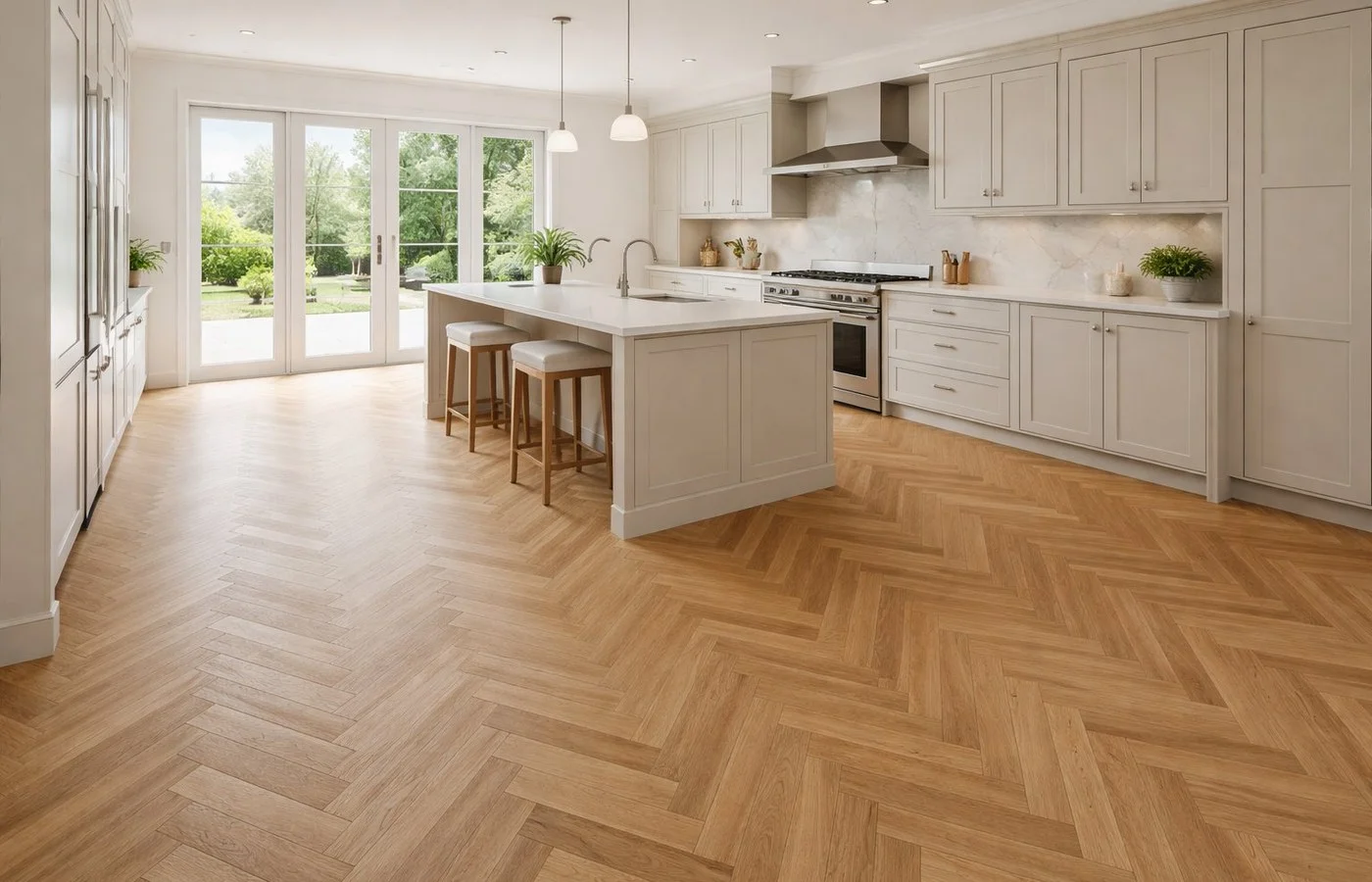
The proportions of the individual block have a significant effect on the character of the finished floor. Narrow, short blocks — in the traditional parquet proportion of roughly 7:2 — give a dense, busy surface that reads as texture from a distance. Wider, longer blocks — the engineered herringbone format at around 120 × 600mm or 150 × 600mm — give a more relaxed, contemporary result that retains the pattern without dominating the room.
For most modern kitchens, the larger format is the better choice. It works with island units and open shelving rather than competing with them.
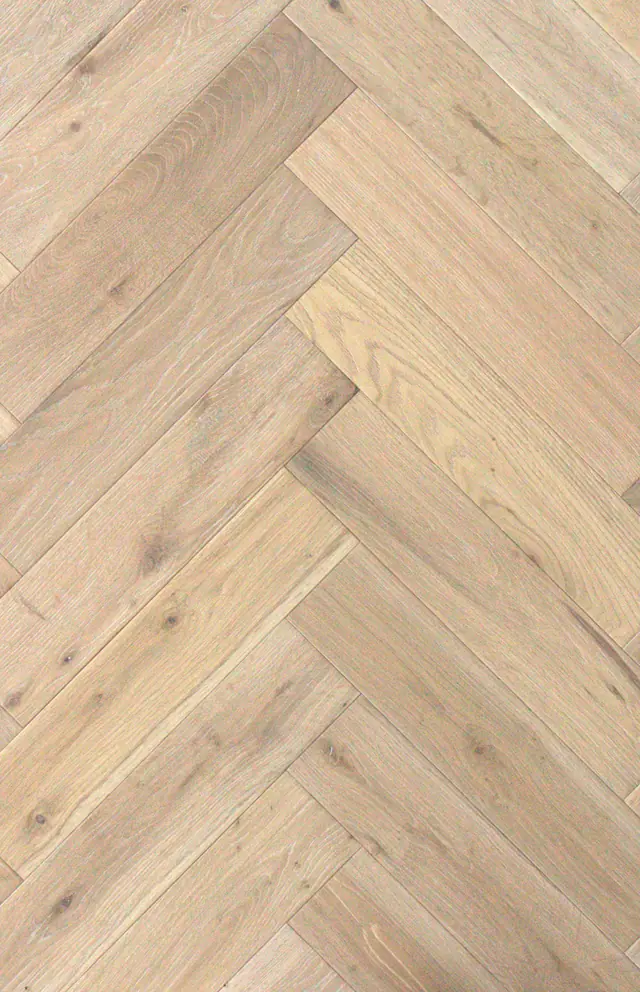
Herringbone in a kitchen tends to work best in mid tones — not so pale that every mark shows, not so dark that the pattern is lost to shadow. A natural or lightly oiled oak, a light smoked finish, or a wire-brushed grey-brown sits in that range well. Matte or satin finishes outperform gloss in kitchens: they are more forgiving of everyday marks and easier to maintain.
The pattern has survived for centuries because it earns its place. In the kitchen, it continues to do exactly that.
Kitchen subfloors are almost always concrete or screed — which suits glue-down herringbone installation perfectly. Glue-down is the most stable fixing method for herringbone, eliminating the minor board movement that can develop in a floating installation over time. It is also the correct choice above underfloor heating, which is now specified in the majority of kitchen extensions we work in.
The datum line — the central axis from which the herringbone is set — should be positioned relative to the kitchen island or the primary sightline from the seating area, not from the perimeter walls. A herringbone that is geometrically centred on a room but visually off-centre from where you stand looks wrong even if it is technically accurate.
The finish in a kitchen should be lacquer rather than oil — lacquer forms a protective film that handles liquid more robustly than a penetrating oil. A satin lacquer is the most practical and the most sympathetic to the character of the herringbone pattern. Matt lacquer can look flat in a kitchen; gloss is too formal for most residential kitchens.
A few floors from the range. Each has its own page with the full specification, a spec sheet and a free sample posted to you.


We would rather understand your room before recommending anything. Order free samples, or send us a photo and tell us about it.